Creado / actualizado por Horst Salzwedel en febrero de 2026.
Seguir leyendo...2 Biótica
La dimensión “Biótica” se entiende como todo lo que tiene que ver con la parte viva de la Ecorregión.
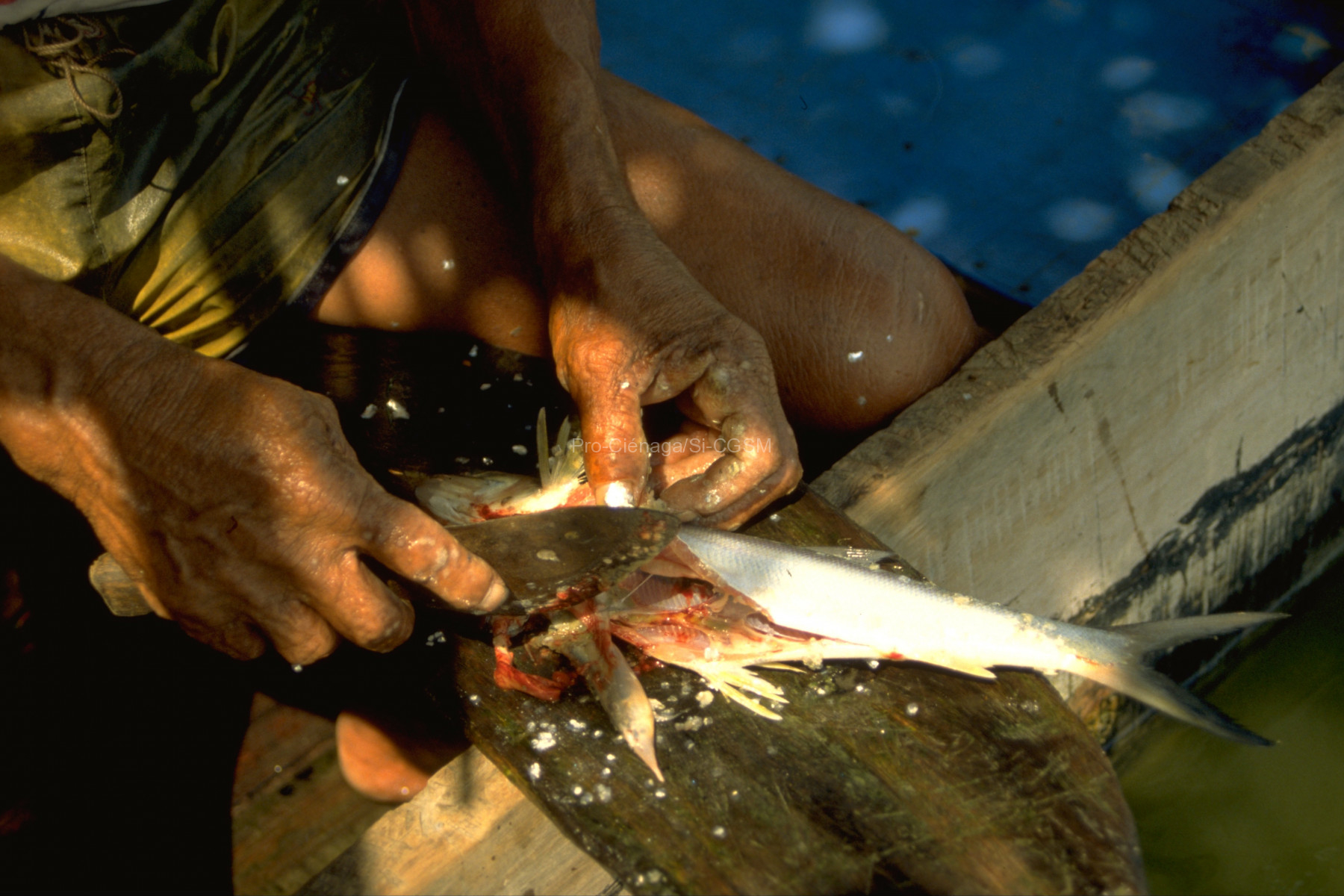
Mercado Silgado, J. E., & Suárez, C. H. (1978). Autoecología y algunos aspectos bioestadísticos del Mugil brasiliensis Agassiz, 1829 de la Costa Atlántica de Colombia. Cartagena 1975. INDERENA – Divulgación Pesquera, 12(4, 5), 40.
El presente trabajo es un estudio autoecológico del lebranche Mugil brasiliensis en diferentes medios acuáticos, además se relacionaron algunos aspectos bioestadísticos con los lebranches capturados en...
Seguir leyendo...Cloern, J. E., Foster, S. Q., & Kleckner, A. E. (2014). Phytoplankton Primary Production in the World’s Estuarine-Coastal. Biogeosciences, 11, 2477-2501.
https://docslib.org/doc/10254224/phytoplankton-primary-production-in-the-worlds-estuarine-coastal Estuaries are biogeochemical hot spots because they receive large inputs of nutrients and organic carbon from land and oceans to support high rates of metabolism...
Seguir leyendo...Thorson, T. B., Brooks, D. R., & Mayer, M. A. (1983). The evolution of freshwater adaptation in stingrays. Natn. Geogr. Soc. Res. Rep., 15, 663-694.
https://www.researchgate.net/publication/247871430_The_evolution_of_freshwater_adaptation_in_stingrays Elasmobranch fishes (sharks, skates, and rays) include species inhabiting the full spectrum of environmental salinity, and ranging from fully marine species, through those exhibiting all...
Seguir leyendo...Water Surface Area Covered by Aquatic Vegetation in the Pajarales Complex (CGSM) Oct 2024 – Oct 2025
https://docs.google.com/presentation/d/1Vh3q8sXkEGkjPlRoBNh73luoTfQ5jALXhJKHRV1hXgs/edit?usp=sharing
Seguir leyendo...Aldana-Domínguez, J., Montes, C., Martínez, M., Medina, N., Hahn, J., & Duque, M. (2020). Biodiversity and Ecosystem Services Knowledge in the Colombian Caribbean: Progress and Challenges. Tropical Conservation Science, 10(1).
https://doi.org/10.1177/1940082917714229 The Colombian Caribbean, one of the most biodiverse regions in the world, is facing great challenges in biodiversity conservation due to accelerated ecosystem transformations and...
Seguir leyendo...Mancera Pineda, J. E., Arteaga Sogamoso, E., & Salzwedel, H. (2025). Harmful phytoplankton in Ciénaga Grande de Santa Marta: The Largest Lagoon-Delta Ecosystem in the Colombian Caribbean. UNESCO Harmful Algae News 80: 18-20.
DCA https://doi.org/10.5281/zenodo.17220270 A thorough review of the extant studies was conducted to assess which phytoplankton species reported since 1996 in the Ciénaga Grande de Santa Marta...
Seguir leyendo...Salzwedel, H. (2025). Biodiversidad Aviar en la Ecorregión Ciénaga Grande de Santa Marta: un Análisis Sistemático de Datos Históricos y Contemporáneos (1968–2024) / Avian Biodiversity in the Ciénaga Grande de Santa Marta Ecoregion: a Systematic Analysis of Historical and Contemporary Data (1968–2024).
DCA La Ecorregión Ciénaga Grande de Santa Marta (CGSM) es un socio-ecosistema de gran importancia ecológica, conocido por su productividad y biodiversidad excepcionales. Desde 2016, se...
Seguir leyendo...Hydrilla verticillata
CEMarin.org, 1 Oct 2025: Ecosistema en riesgo: cómo la pérdida del régimen hídrico abrió la puerta a la Hydrilla verticillata / Ecosystem at Risk: How the...
Seguir leyendo...Acosta Escorcia, E. P. (2012). Caracterización espacial y temporal de la estructura de la comunidad de fitoplancton y su correlación con algunas variables ambientales locales en la Ciénaga Grande de Santa Marta, Caribe colombiano [Grado]. Univ. Ind. Santander, Fac. Ciencias, Escuela Biol. 132 p.
DAC El objetivo de este estudio fue caracterizar a nivel espacial y temporal la estructura de lacomunidad de fitoplancton en la Ciénaga Grande de Santa Marta...
Seguir leyendo...